6 pillars of character + embroidery art lesson
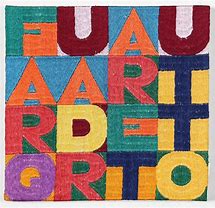
The following is a 5th grade art lesson based on the work of artist Alighiero Boetti + his work with Afghan embroiderers.
The 6 pillars of character were used for the imagery on student work. (trustworthiness - respect -responsibility - fairness - caring - citizenship) It is said that the Six Pillars of Character can dramatically improve the ethical quality of our decisions, + thus our character + lives. The pillars of character were choices students had for subject matter in their artwork.
Scroll down to find:
The 6 pillars of character were used for the imagery on student work. (trustworthiness - respect -responsibility - fairness - caring - citizenship) It is said that the Six Pillars of Character can dramatically improve the ethical quality of our decisions, + thus our character + lives. The pillars of character were choices students had for subject matter in their artwork.
Scroll down to find:
- examples of the artist, his work + Agfhan embroiderers' work
- step-by-step instructions with pictures of the project
- a lesson plan (including California State Visual Art Standards)
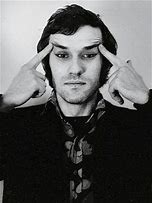
reference photos of artist Alighiero Boetti + his works
- Italian born conceptual artist
- Embarked on a series of projects with Afghan embroiderers
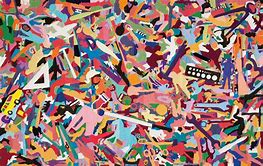
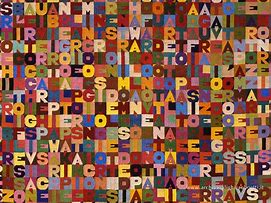
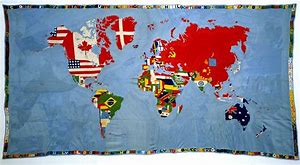
- These textiles are the artist's most iconic pieces, a photo of the artist + other art by artist.
|
|
|
|
|
|
Afghan Embroiderers - UCLA installation 2012
Order and Disorder: Alighiero Boetti by Afghan Women
February 26–July 29, 2012
From 1971 to 1994, Italian artist Alighiero Boetti (1940–1994) embarked on a series of projects with Afghan embroiderers, creating monumental pieces that would become some of the artist’s most iconic works. Working first in Kabul in the 1970s and then in refugee camps in Pakistan after the 1979 Soviet occupation of Afghanistan, Afghan women embroidered works based on Boetti’s templates that include: colorful grids of letters that spell out phrases (such as “Order and Disorder”); Mappe (maps), wall-sized world maps with countries filled-in with the colors and symbols of their flags; andTutto (everything), large-scale works entirely filled with intricately embroidered shapes representing diverse objects—sunglasses, a Hindu goddess, a protractor, twins, and more. The exhibition features twenty-nine works by Boetti along with documentary photographs of the Afghan embroiderers taken in 1990 at Boetti’s request by Randi Malkin Steinberger, as well as examples of the traditional styles of embroidery that might have played a role in stimulating Boetti’s best-known works.
29 pieces by Boetti appear with documentary photographs of women who embroidered his works, as well as examples of traditional Afghan textiles that inspire the artist to this pursuit.
Afghan women embroiderers are respected among their piers.
February 26–July 29, 2012
From 1971 to 1994, Italian artist Alighiero Boetti (1940–1994) embarked on a series of projects with Afghan embroiderers, creating monumental pieces that would become some of the artist’s most iconic works. Working first in Kabul in the 1970s and then in refugee camps in Pakistan after the 1979 Soviet occupation of Afghanistan, Afghan women embroidered works based on Boetti’s templates that include: colorful grids of letters that spell out phrases (such as “Order and Disorder”); Mappe (maps), wall-sized world maps with countries filled-in with the colors and symbols of their flags; andTutto (everything), large-scale works entirely filled with intricately embroidered shapes representing diverse objects—sunglasses, a Hindu goddess, a protractor, twins, and more. The exhibition features twenty-nine works by Boetti along with documentary photographs of the Afghan embroiderers taken in 1990 at Boetti’s request by Randi Malkin Steinberger, as well as examples of the traditional styles of embroidery that might have played a role in stimulating Boetti’s best-known works.
29 pieces by Boetti appear with documentary photographs of women who embroidered his works, as well as examples of traditional Afghan textiles that inspire the artist to this pursuit.
Afghan women embroiderers are respected among their piers.
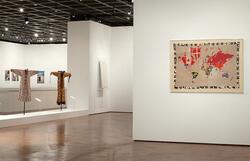
Fowler Museum at UCLA in 2012
|
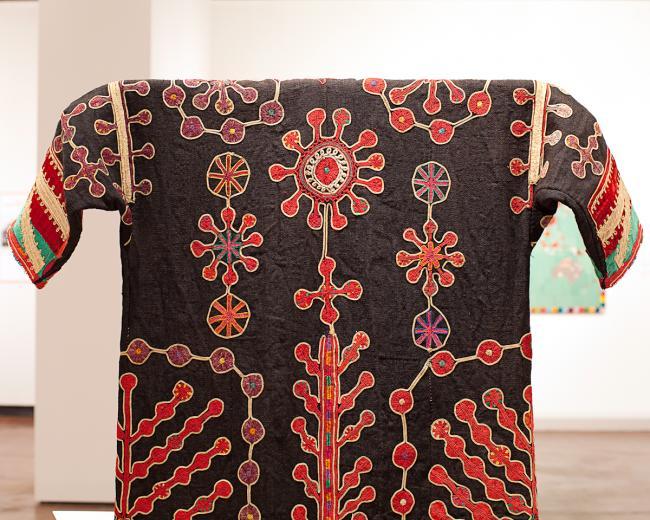
traditional embroidery on clothes
|
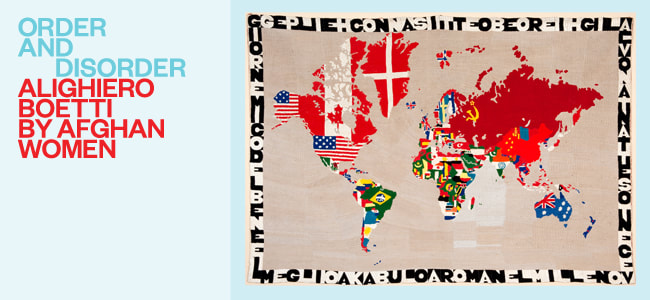
Alighiero Boetti, Mappa, 1979 - embroidery on fabric, 126x88 cm - Collection of Audrey Irmas, Los Angeles - photo by Don Cole - UCLA Fowler Museum
|
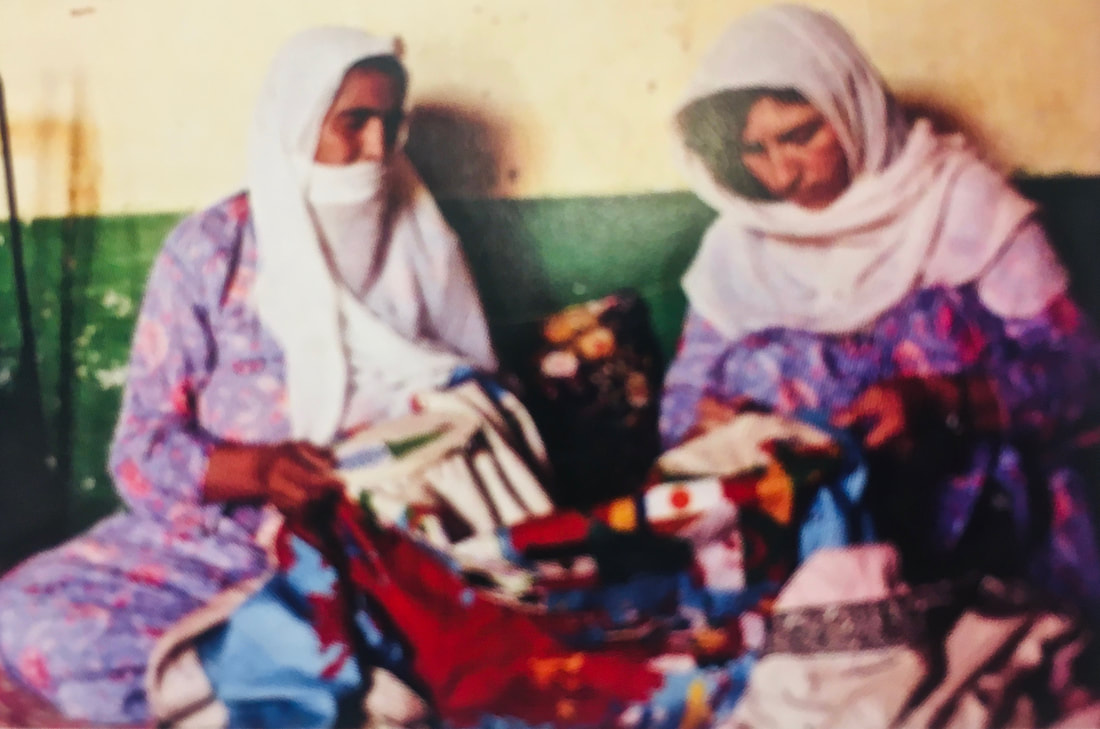
2 women work together on a Mappa, 1990 - image from Order an Disorder: Alighiero Boetti by Afghan women - photo by Randi Malkin Steinberger, 1990
|
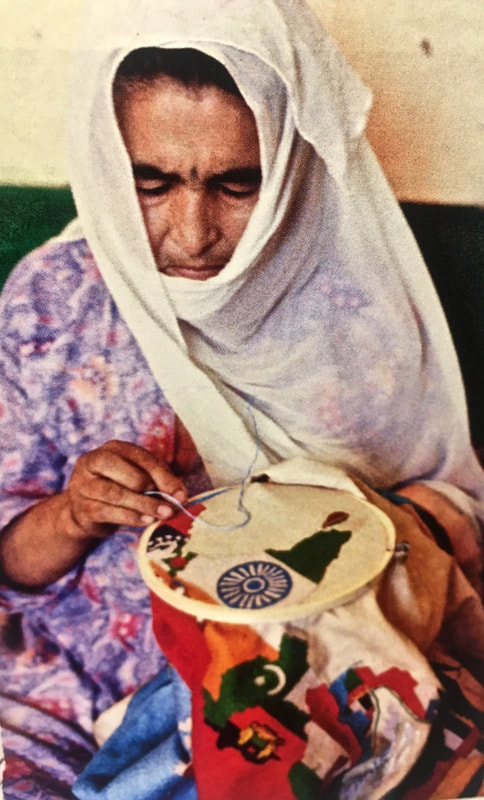
An older woman stitches on Mappa.
|
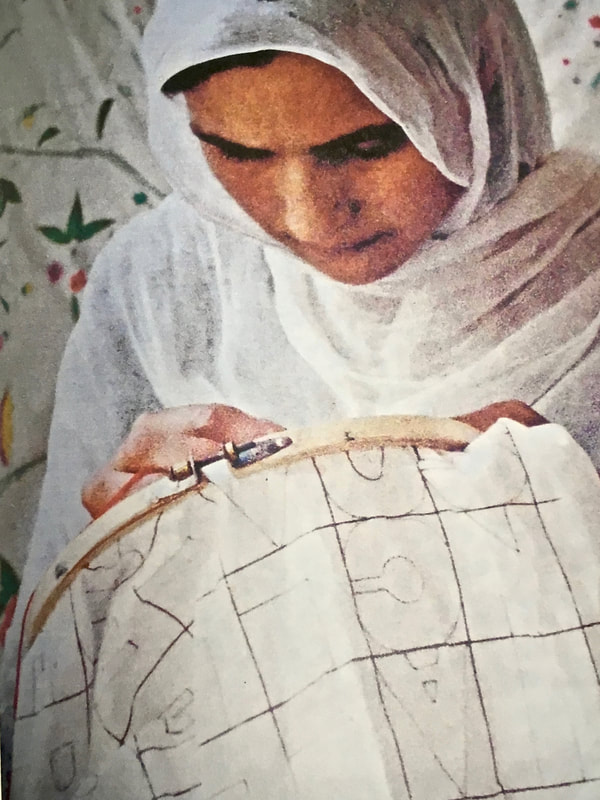
embroiderers drew image on fabric prior to stitching - similar to what students do
|
step-by step instructions
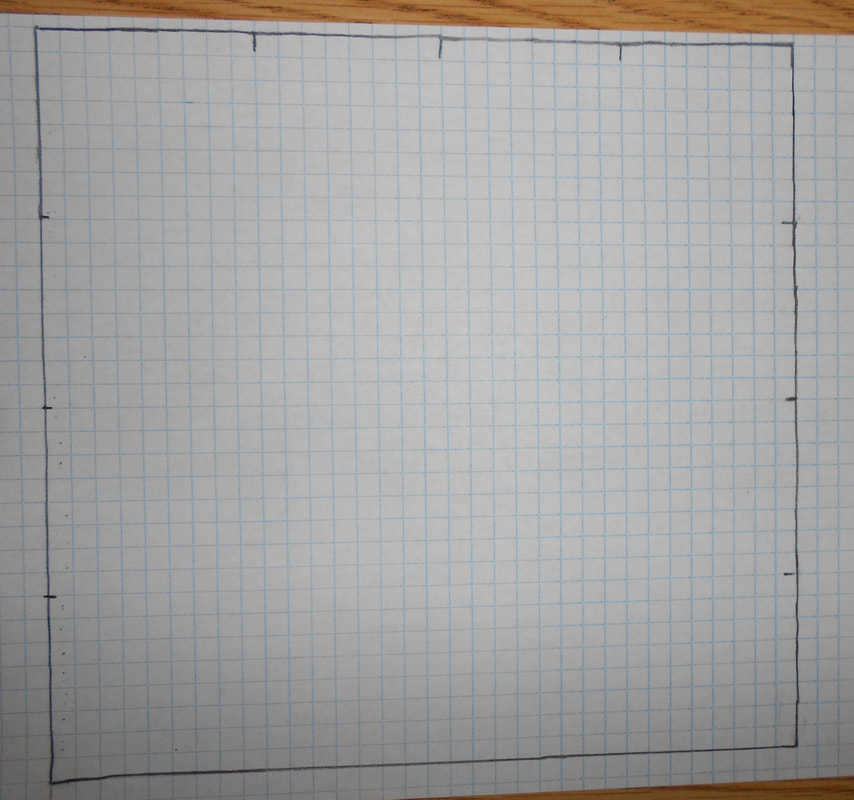
1. count off grid squares for your project - I used 8 vertical + horizontal because that is what fit on the grid paper
|
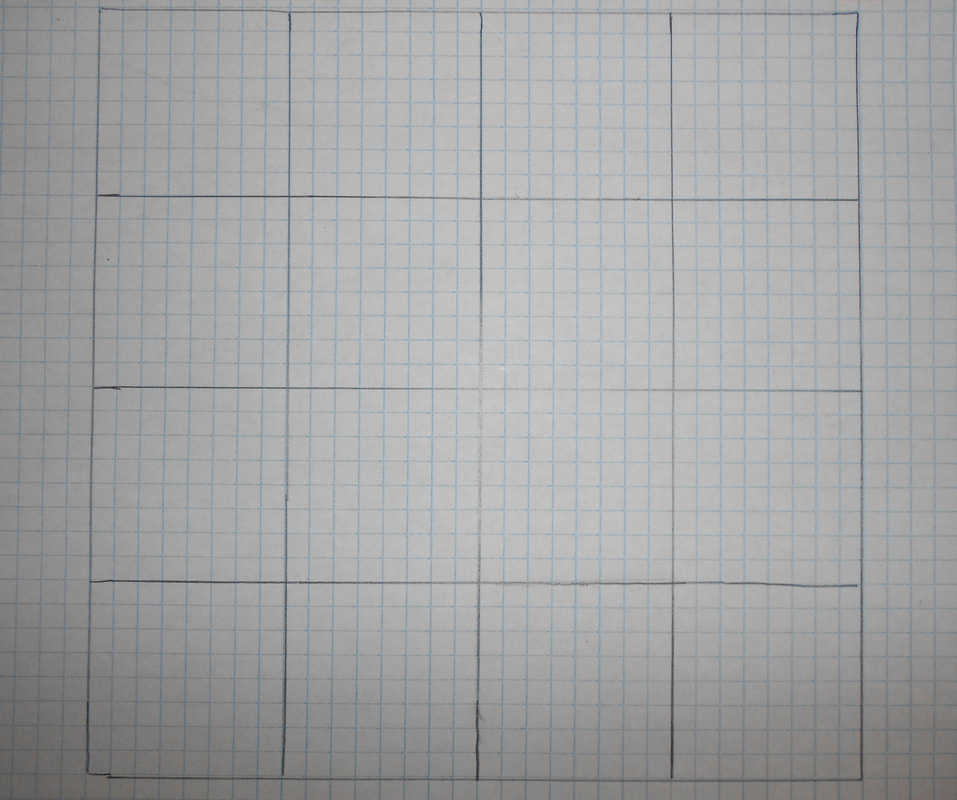
2. draw lines separating inner squares using a straight edge - follow the grid paper lines - end up with an even square
|
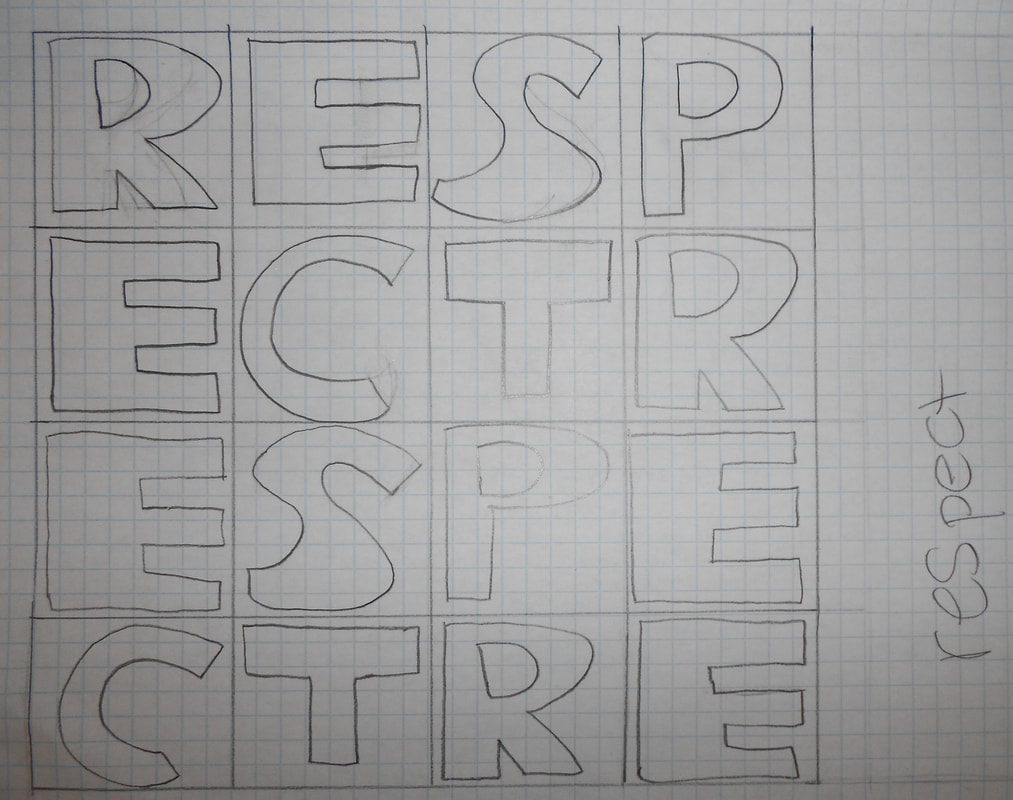
3. I used words from the pillars of character - shortening them - write word in squares vertically or horizontally until there are no more squares - last word may be incomplete
|
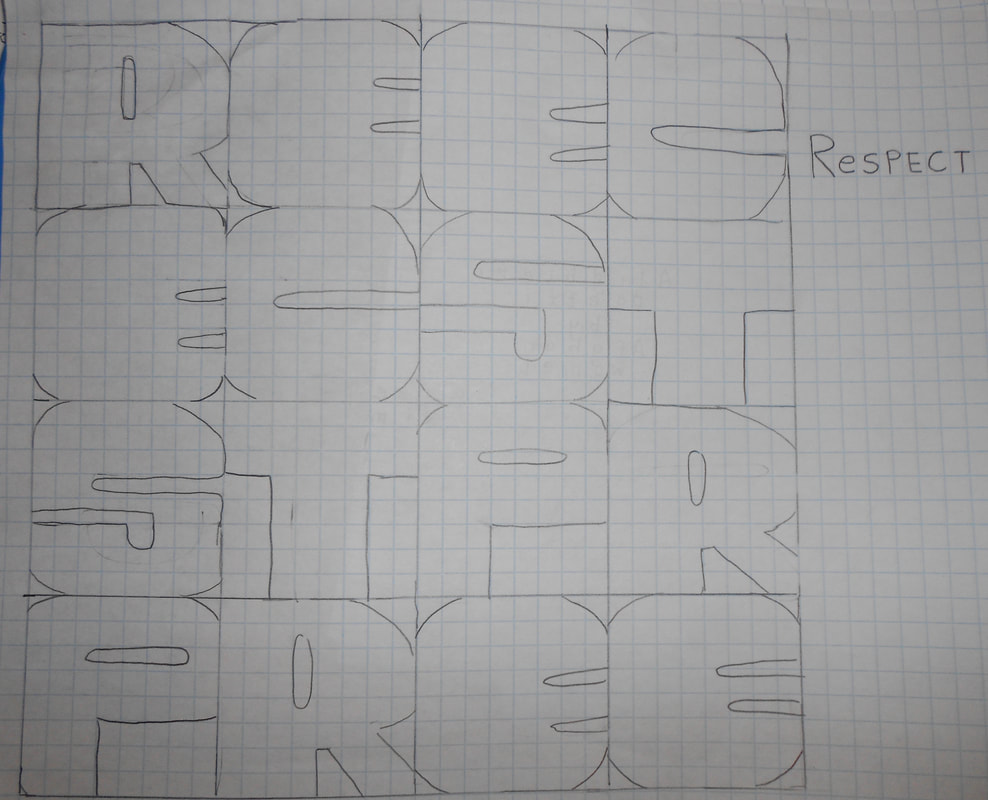
4. words reading vertically - allow students to stylize their letters - letters should go to edges of small squares or boxes - RESPECT is word chosen
|
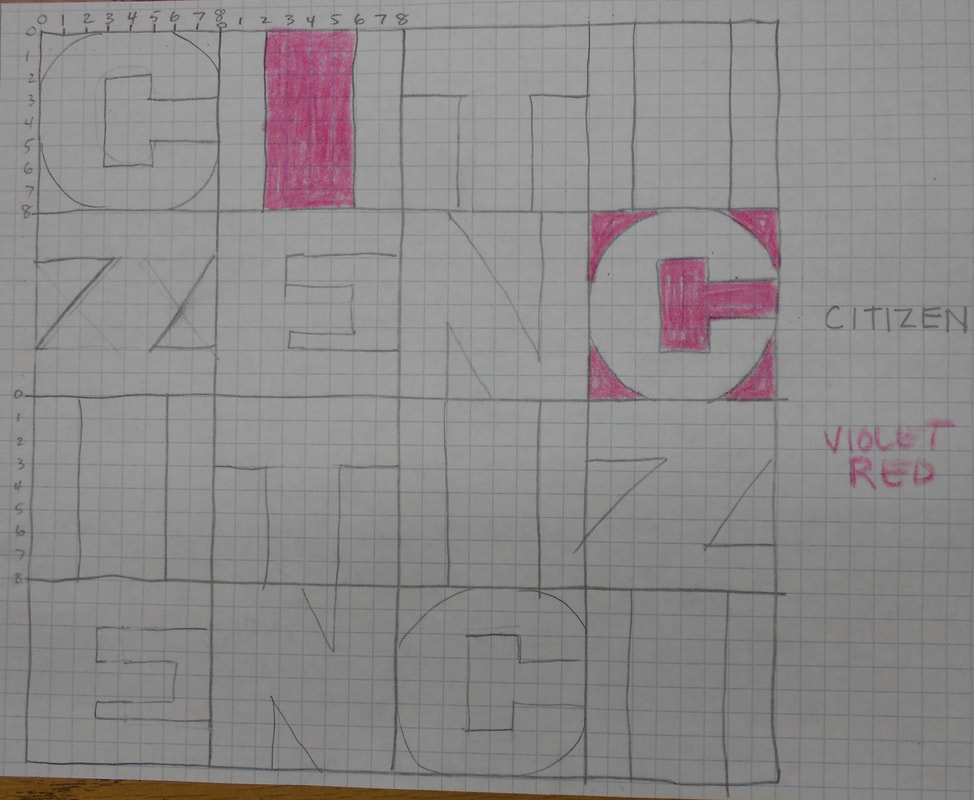
5.start with one color - color both the background + letter - vary through-out - I tried one on each row, but let students color where they want - CITIZEN is word chosen (Citizenship)shortened from
|
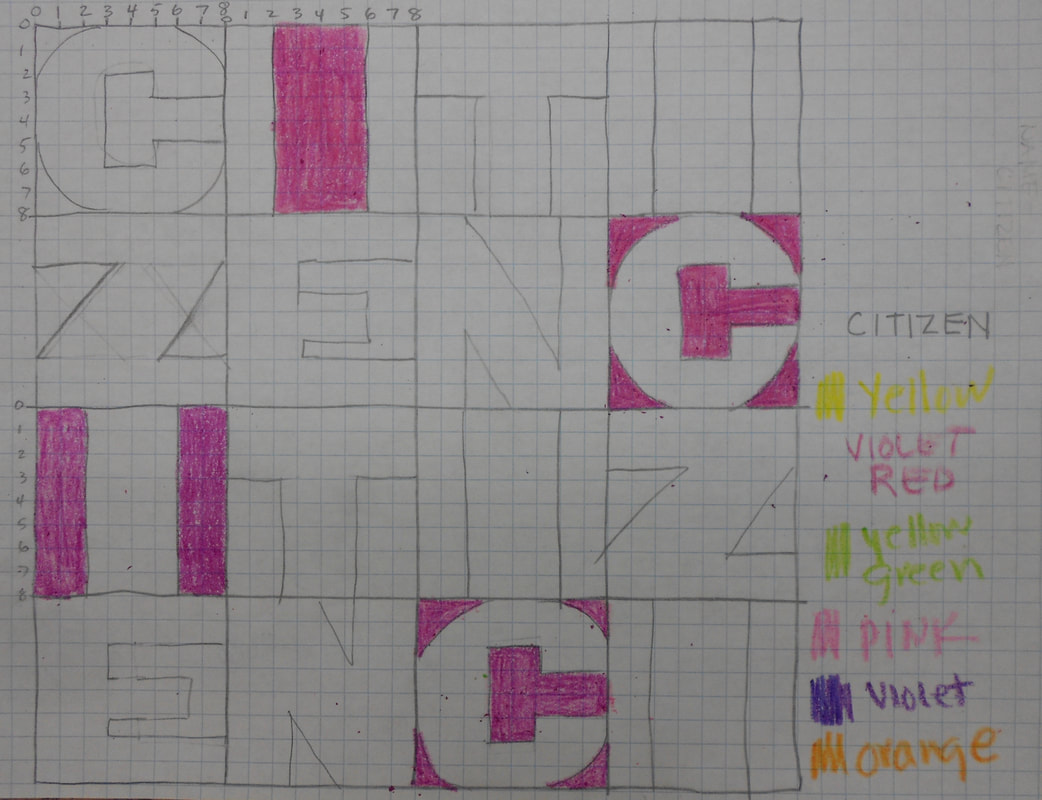
6. spread your color through-out the artwork - no 2 next to each other are the same color
|
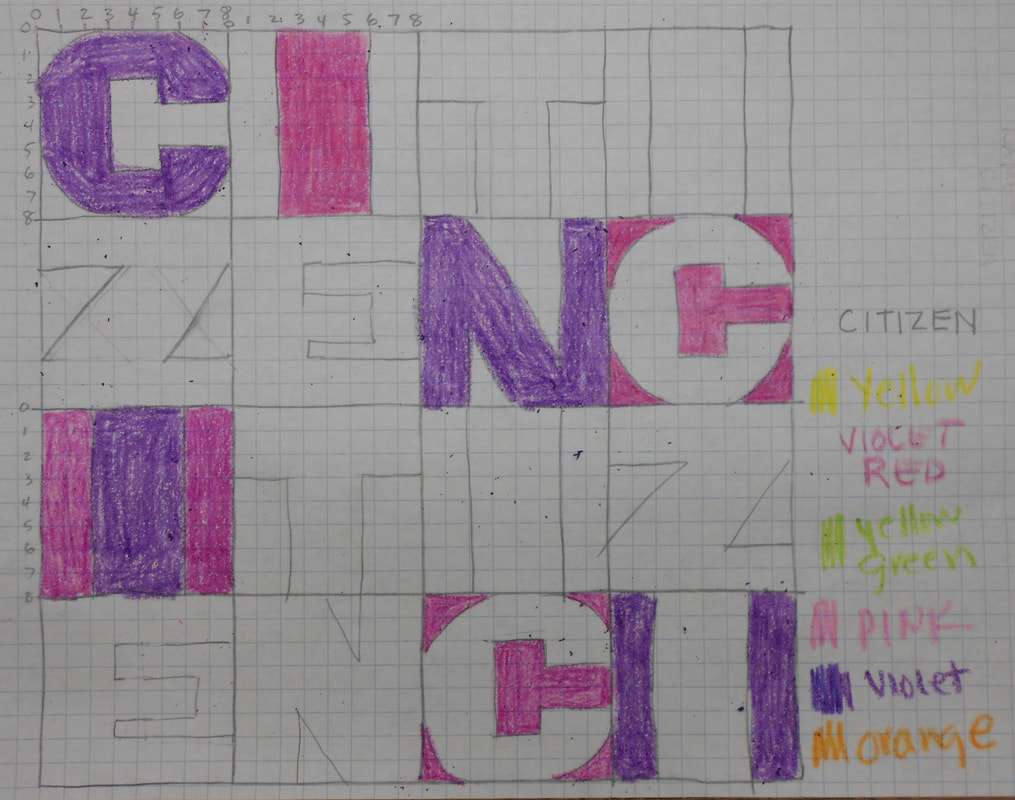
7. start, the same way, using a 2nd color
|
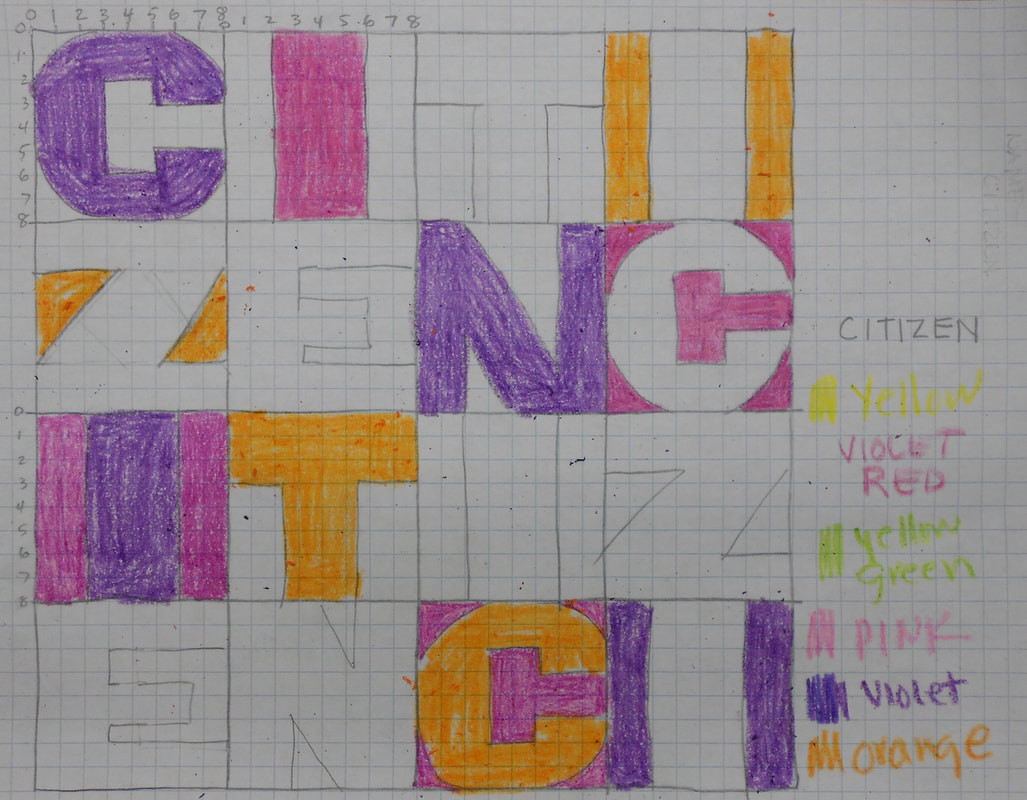
8. add a 3rd color
|
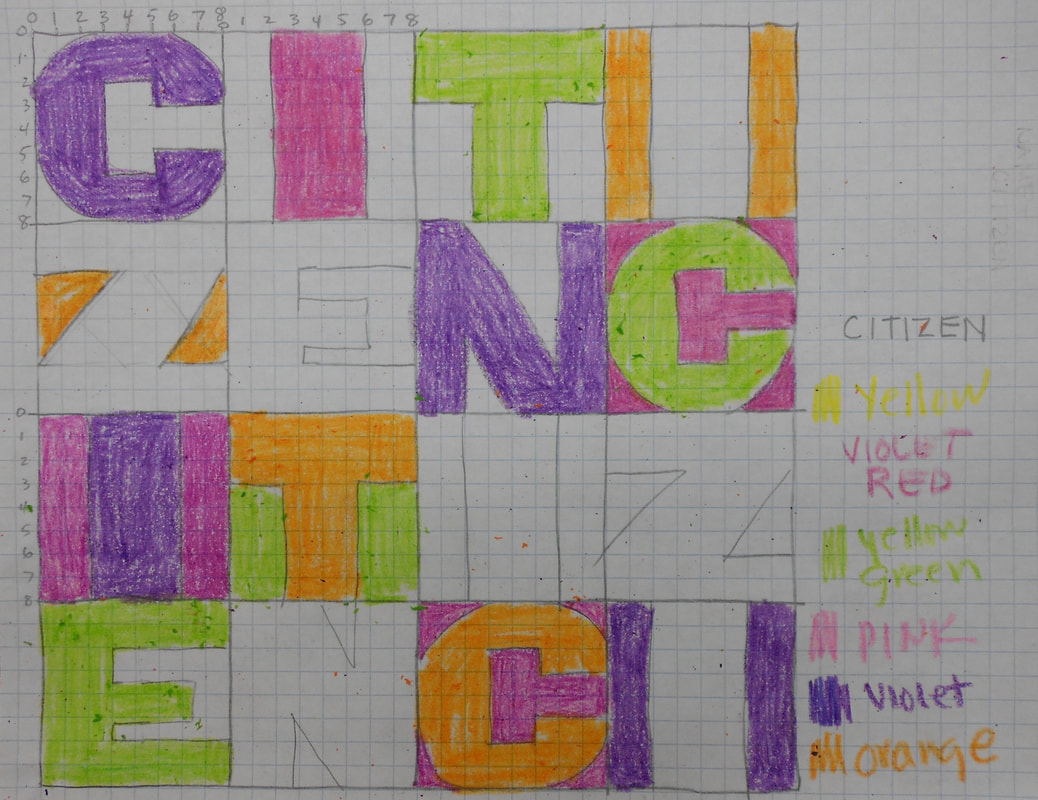
9. then add a 5th color
|
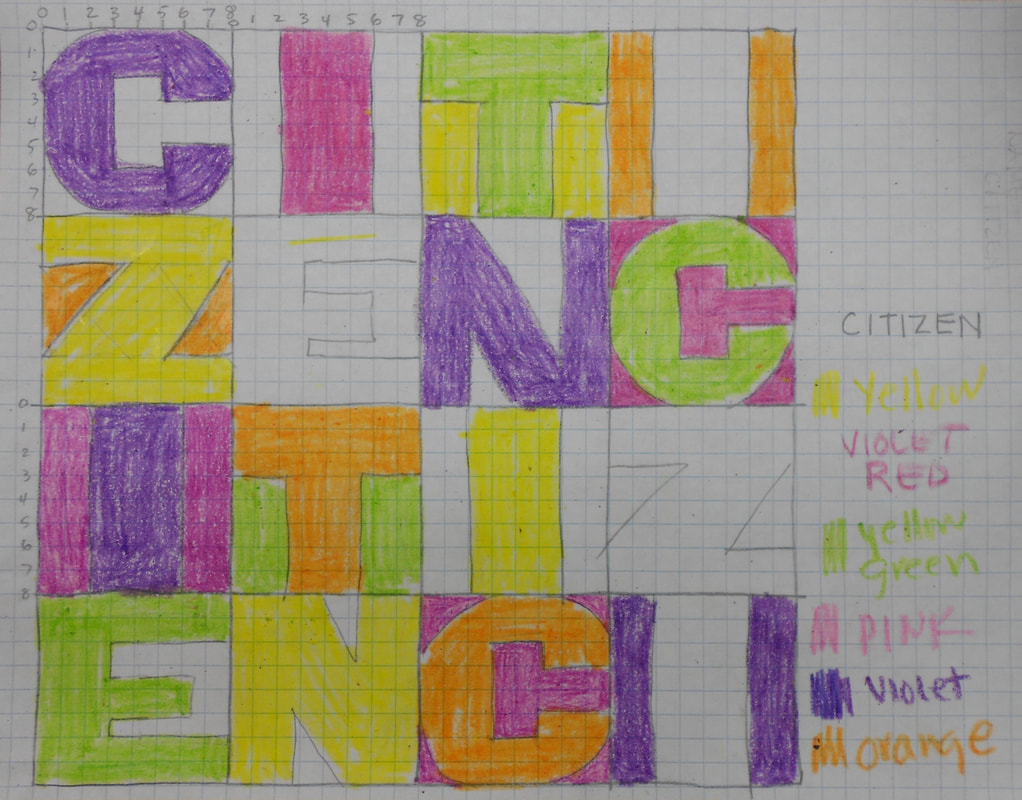
10. 6th color - last color chosen - NOTE: students make a schedule on side of colors they will use for design
|
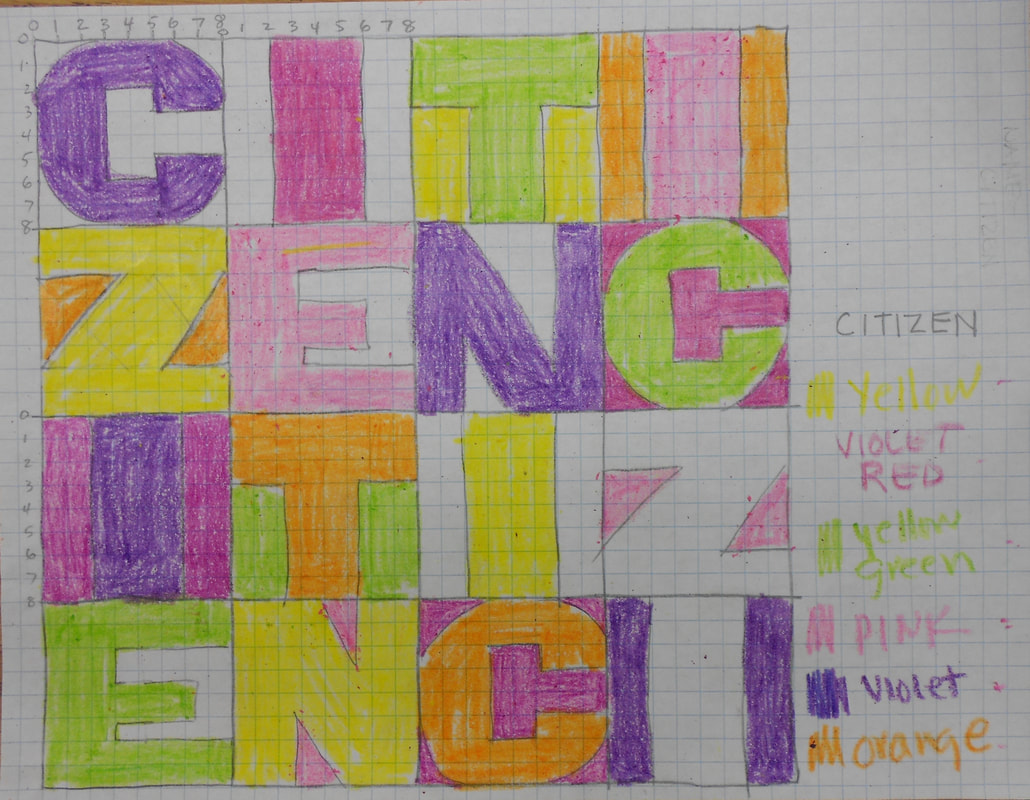
11. fill in the entire artwork - every letter + background
|
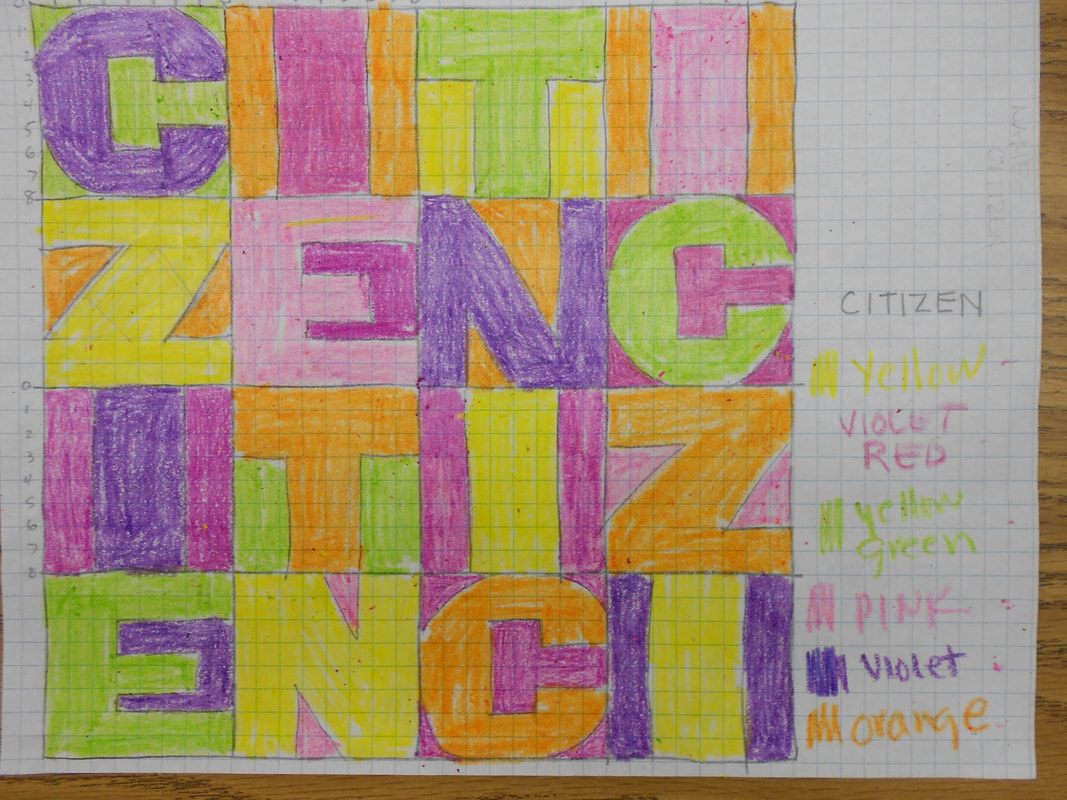
12. continue until all boxes are are fully colored
|
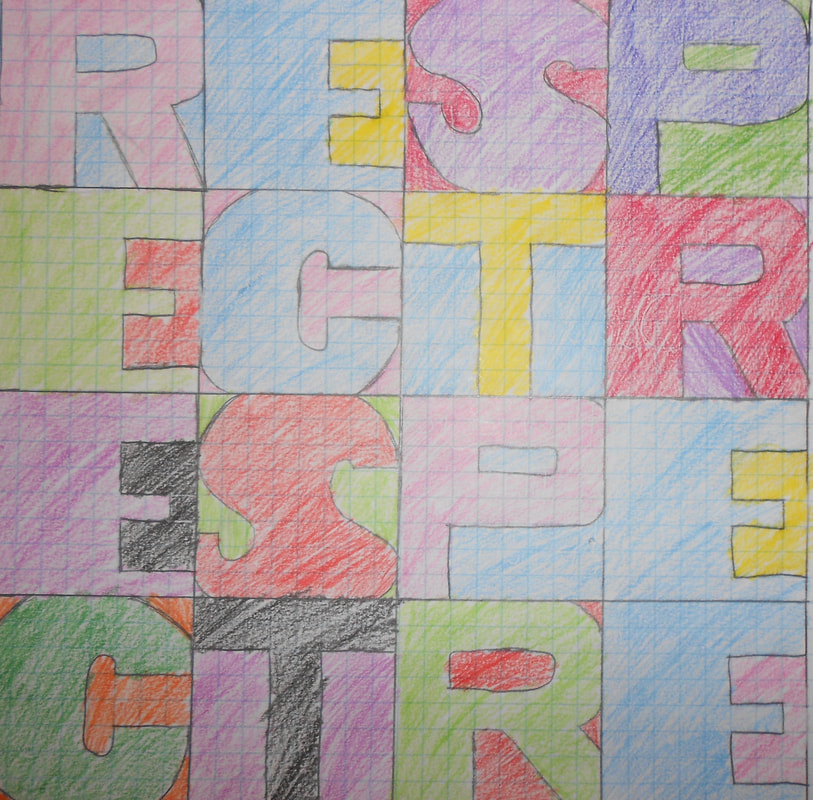
14. student work complete using colored pencils - notice the line work is uniform through out
|
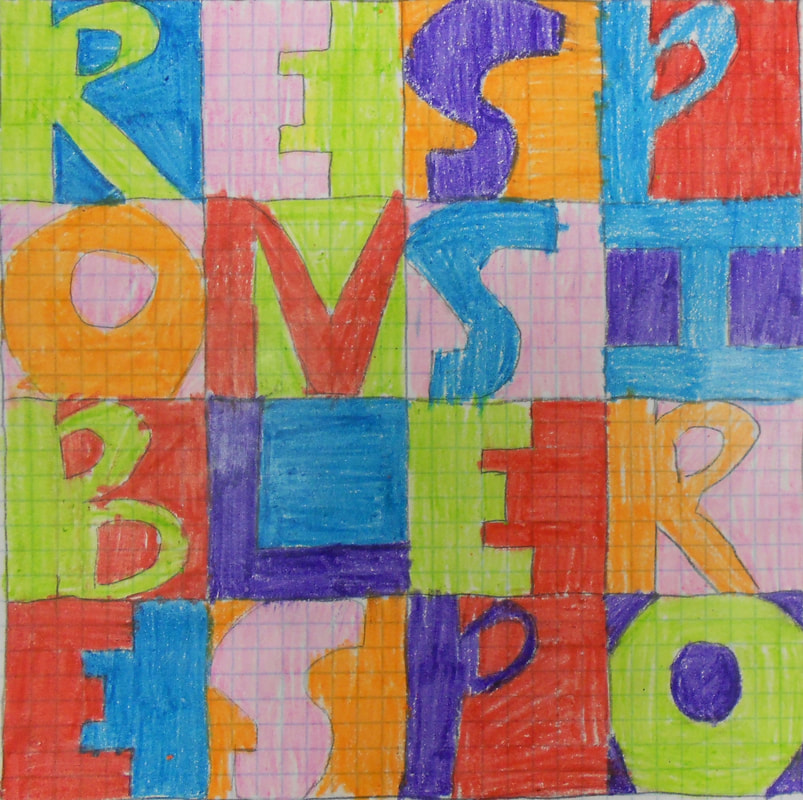
15. completed color pencil - darker coloring on this - students may choose their coloring tool
|
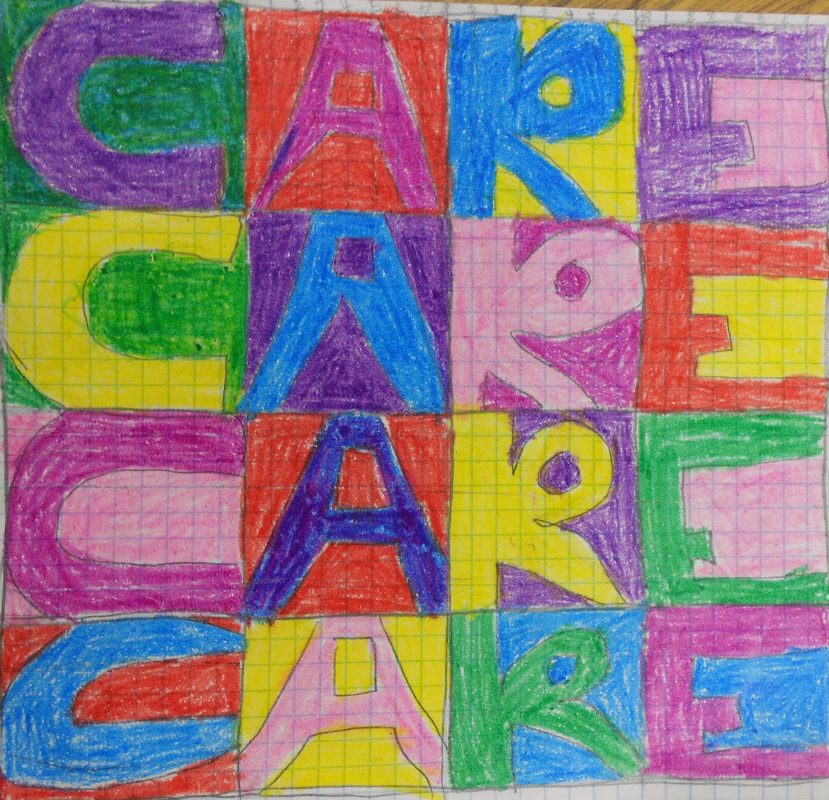
16. words with 4 letters for a variation
|
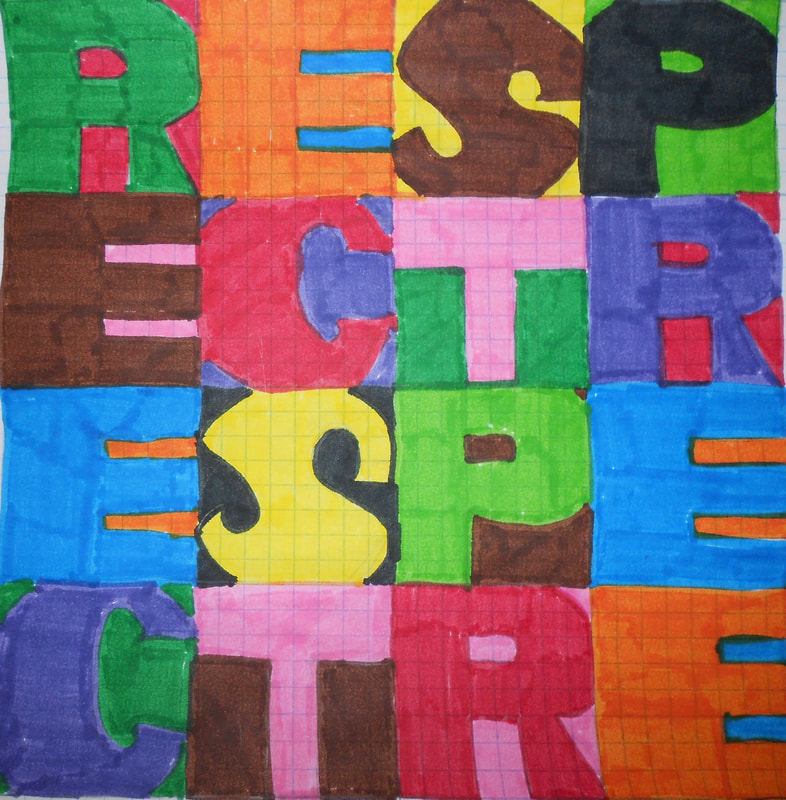
17. completed example colored with markers
|
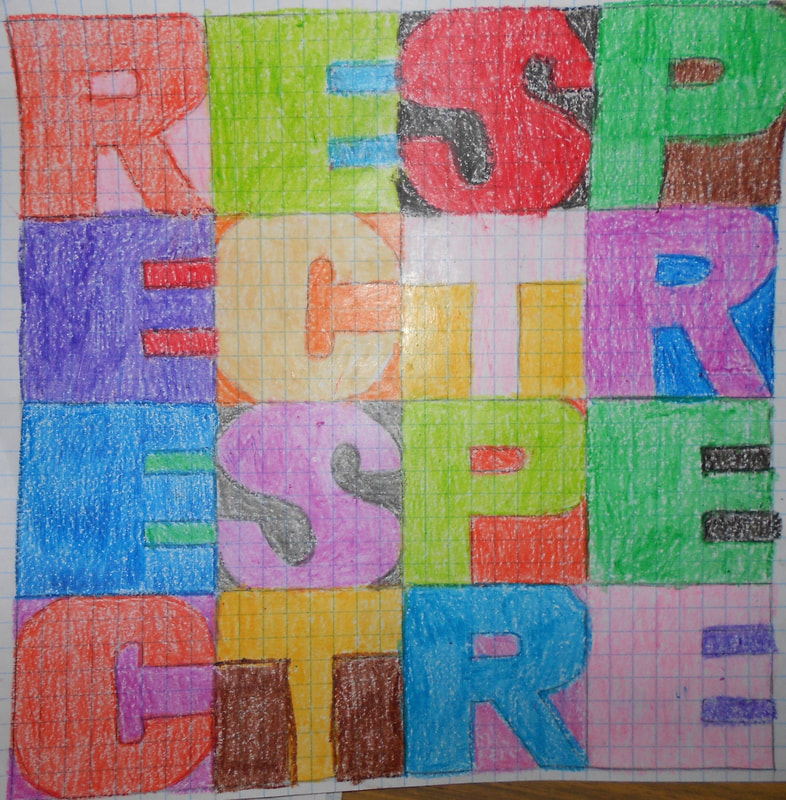
18. completed work using crayons
|
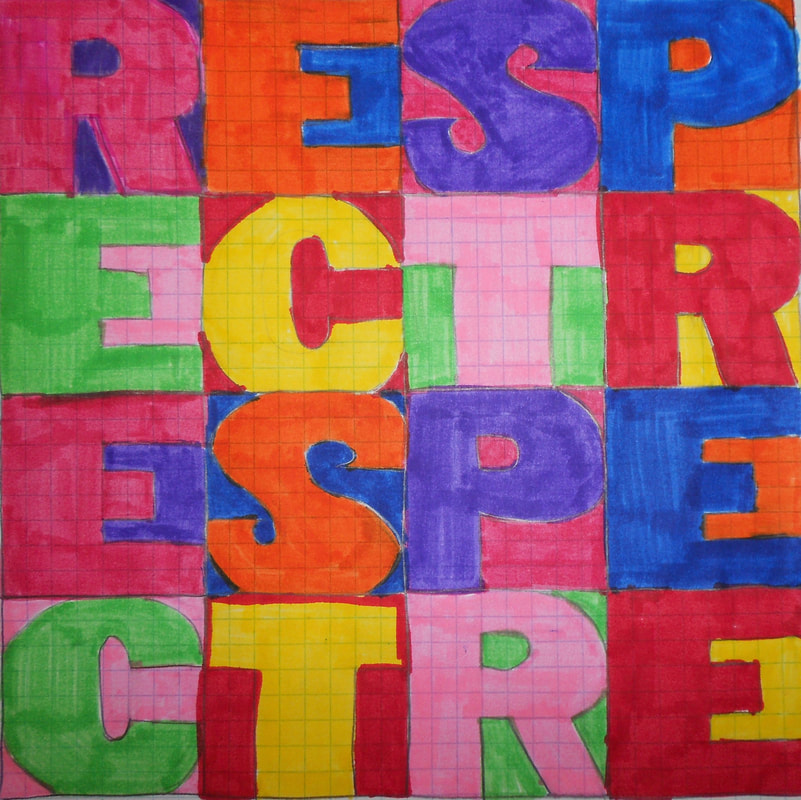
19. completed artwork - medium is marker
|
objective
Students will have knowledge of Afghan women and their skill in embroidery. They will be familiar with the artist Alighiero Boetti and his monumental series of art pieces. They will know how to use graph paper to construct grids to created their own work of art. They will know how to abstract words from the pillars of character to condense into hand drawn quilts.
materials
- 8-1/2"x11" grid paper (or any size grid paper with 1/4" squares or larger)
-pencils
- erasers
- colored pencils
-crayons
- markers
- pencil sharpener for colored pencils
-pencils
- erasers
- colored pencils
-crayons
- markers
- pencil sharpener for colored pencils
activity
- introduce to class the Afghan women weavers
- introduce artist to class
- show students quilts designed by the featured artist
- follow the step-by-step instructions
- allow students to choose their medium to use for color
- students have the choice whether to color dark or light or stitching directional coloring
- introduce artist to class
- show students quilts designed by the featured artist
- follow the step-by-step instructions
- allow students to choose their medium to use for color
- students have the choice whether to color dark or light or stitching directional coloring
vocabulary
- Balance - Visual equilibrium in a composition; achieved by organizing the weight and attention of all elements in an artwork. Types of balance are symmetrical, asymmetrical, radial, and crystallographic.
- Color - The visual sensation dependent on the reflection or absorption of light from a given surface. The three characteristics of color are hue, value, and intensity.
- Composition - The organization of elements in a work of art.
- Cool colors - Colors suggesting coolness: blue, green, + purple.
- Elements of art - sensory components used to create works of art: line, color, shape/form, texture, value, space.
- Geometric - Refers to shapes or forms pertaining to geometry.
- Harmony - The principle of design that combines elements in a work of art to emphasize the similarities of separate but related parts.
- Line - A point moving in space. Line can vary in width, length, curvature, color, or direction.
- Nonobjective - Having no recognizable object as an image. Also called nonrepresentational.
- Organic - Refers to shapes or forms having irregular edges or to surfaces or objects resembling things existing in nature.
- Pattern - Anything repeated in a predictable combination.
- Proportion - The size relationships of one part to the whole and of one part to another.
- Scale - The size of an object or image that is measured by its relationship to the other objects and images that are recognized for their normal or actual size.
- Space - An area in which objects or images can exist.
- Shape - A two-dimensional are or plane that may be open or closed, free-form or geometric. It can be found in nature or is made by humans.
- Unity - Total visual effect in a composition achieved by the careful blending of the elements of art + the principles of design.
clean-up
- there is not much clean-up with this lesson
- collect artwork papers
- put away properly drawing material (markers + colored pencils)
- collect artwork papers
- put away properly drawing material (markers + colored pencils)
variation
- students may choose from a variety of coloring mediums - see above for examples
- size of project varies with grid size +/or paper size
- choose another theme for words to use - may related to any lesson
- size of project varies with grid size +/or paper size
- choose another theme for words to use - may related to any lesson
Ca state visual arts standards
1.0 ARTISTIC PERCEPTION
Develop Perception Skills and Visual Arts Vocabulary
1.2 Identify and describe characteristics of representational, abstract, and nonrepresentational works of art.
3.0 HISTORICAL and CULTURAL CONTENT
Role and Development of the Visual Arts
3.3 Identify and describe various fine, traditional, and folk arts from historical periods worldwide.
Make Informed Judgements
4.4 Assess their own works of art, using specific criteria, and describe what changes they would make for improvement.
Develop Perception Skills and Visual Arts Vocabulary
1.2 Identify and describe characteristics of representational, abstract, and nonrepresentational works of art.
3.0 HISTORICAL and CULTURAL CONTENT
Role and Development of the Visual Arts
3.3 Identify and describe various fine, traditional, and folk arts from historical periods worldwide.
Make Informed Judgements
4.4 Assess their own works of art, using specific criteria, and describe what changes they would make for improvement.